Data Centers in Space and Ocean

What Happened
They say there are no permanent enemies in Politics. It seems the same is true in AI. Anyway, the reason I bring it up is Elon Musk has repeatedly criticized Anthropic (calling them MisAnthropic) and has a famous feud with OpenAI because they veered from their nonprofit roots (BTW, he took them to court over this, and lost yesterday). A few days later we heard that Anthropic signed a major agreement with Musk’s SpaceX, securing 100% of the compute capacity at xAI’s Colossus 1 supercomputer in Memphis, Tennessee. The facility, now under SpaceX, houses over 220,000 Nvidia GPUs and consumes approximately 300 megawatts of power. More strikingly, the deal includes explicit interest in partnering to develop multiple gigawatts of orbital AI compute capacity in space. SpaceX’s unmatched launch cadence, reusable Starship economics, and Starlink constellation expertise make this more than pure speculation.
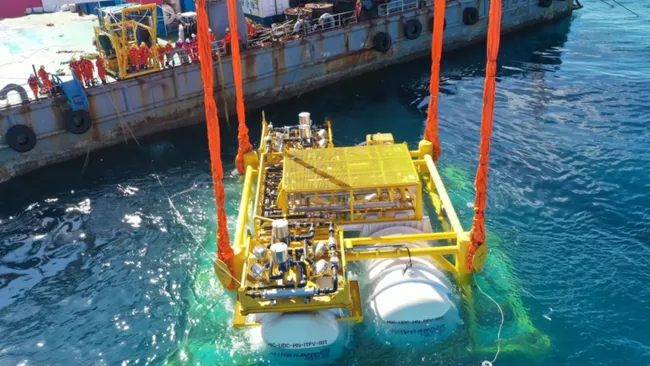
At the same time, off Shanghai’s Lingang Special Area, China has activated the world’s first commercial offshore wind-powered underwater data center. Submerged roughly 10 meters underwater adjacent to offshore wind turbines, the facility uses cold seawater for passive cooling and draws clean electricity directly from the ocean winds. Early phases house around 2,000 servers with plans for significant expansion.
Why This Matters
Explosive growth in frontier AI models, localized reasoning, and multi-agent systems is overwhelming terrestrial infrastructure. Power procurement, grid connections, and cooling have become primary bottlenecks. Orbital and subsea approaches offer radical alternatives: space for abundant solar energy and ocean for natural cooling and renewables integration.
Is this for real though?
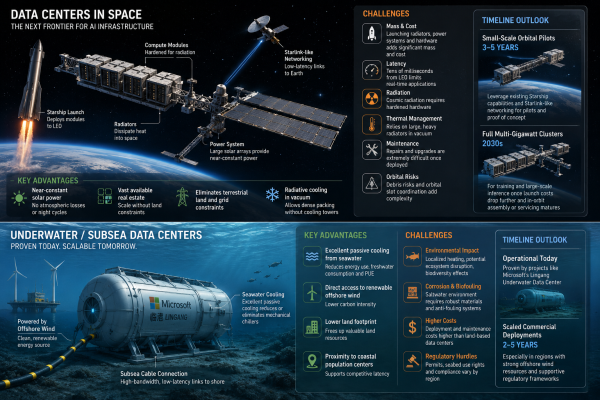
Data Centers in Space : This isn't going to a walk in the sky. Challenges are formidable: launching heavy radiators and power systems adds significant mass and cost; latency (tens of milliseconds from LEO) limits real-time applications; cosmic radiation requires hardened hardware; thermal management relies on large, heavy radiators; and maintenance/repairs are extremely difficult once deployed. Debris risks and orbital slot coordination add complexity. Elon Musk and SpaceX have positioned this as a near-term engineering program rather than distant sci-fi, with collaborations already exploring feasibility. Small-scale orbital pilots could emerge within 3–5 years, leveraging existing Starship capabilities and Starlink-like networking. Full multi-gigawatt clusters for training or large-scale inference are more likely in the 2030s, once launch costs drop further and in-orbit assembly or servicing matures. This would provide near-constant solar power (no atmospheric losses or night cycles), vast available “real estate,” and elimination of terrestrial land and grid constraints. Radiative cooling in vacuum allows dense packing without massive cooling towers.
Underwater/Subsea Data Centers: These are viable today, as demonstrated by the operational Lingang project. Scaling to larger commercial deployments could happen within 2–5 years, especially in regions with strong offshore wind resources. These have excellent passive cooling from seawater (reducing or eliminating mechanical chillers and freshwater use), direct access to renewable offshore wind, lower land footprint, and potentially reduced carbon intensity. Proximity to coastal population centers can support competitive latency. Challenges involve marine environmental impacts (localized heating, potential ecosystem disruption), corrosion and biofouling in saltwater, higher deployment and maintenance costs compared to land, and regulatory hurdles for seabed use. Long-term studies on thermal pollution and biodiversity effects will be essential.
Growing opposition to Data Centers on Earth
Meanwhile, traditional ground-based data centers face mounting resistance. Across the United States and internationally, communities are organizing protests and blocking projects over concerns about massive electricity consumption, water usage for cooling, noise pollution, and limited local job creation. In 2025 alone, billions in proposed projects were delayed or canceled amid bipartisan local opposition, with groups in states like Michigan, Arizona, Utah, and Virginia leading the charge. Calls for national moratoriums have grown, reflecting broader anxiety about the environmental and infrastructural toll of the AI boom on everyday communities.
This grassroots pushback is accelerating interest in alternative locations that minimize local burdens.
What others are saying
Reactions on X reflect both excitement and realism. Elon Musk commented on the Anthropic partnership:
By way of background for those who care, I spent a lot of time last week with senior members of the Anthropic team... No one set off my evil detector. So long as they engage in critical self-examination, Claude will probably be good... I was ok leasing Colossus 1 to Anthropic...Elon Musk
Anthropic hit 80x growth in a single quarter... Elon's response? Hand them his entire 220,000-GPU Colossus One data center. When AI demand is heading toward infinity, even competitors become allies.- Peter H. Diamandis
Discussions on orbital compute highlight both potential and hurdles, with experts noting that radiation hardening, heat rejection, and latency will shape what workloads move to space first - favoring training or batch processing over interactive use. On subsea systems, observers praise China’s deployment for proving immediate efficiency gains with offshore renewables and natural cooling.
🫤 Dileep's Skeptical Takeaway:
The vision of orbital solar-powered clusters or ocean-cooled pods is compelling for bypassing Earth’s power and land constraints while potentially lowering certain environmental footprints. Yet engineering realities - thermal management in space, marine impacts underwater, and overall economics - mean these will complement, rather than quickly replace, terrestrial infrastructure. Orbital systems face steep hurdles before reaching gigawatt scale, while subsea offers nearer-term wins but demands careful ecological oversight. Rapid iteration in a compute-hungry era is certain, but success will hinge on rigorous testing, cost curves, and balanced responsibility.
Sources:
https://x.ai/news/anthropic-compute-partnership
https://www.wired.com/story/anthropic-spacex-compute-deal-colossus/
https://www.datacenterwatch.org/report
https://www.projectcensored.org/communities-against-ai-data-center/
https://www.theguardian.com/business/2026/feb/24/datacenters-ai-construction
Enjoying What the AI?
Get a new edition every week, plus join the conversation on LinkedIn.
Subscribe on LinkedIn