Daybreak vs. Mythos: The AI Cybersecurity arms race
What Happened
Less than 15 hours ago, OpenAI officially launched Daybreak, its dedicated initiative for frontier AI in cybersecurity. Positioned as “Frontier AI for cyber defenders,” Daybreak represents a comprehensive vision to transform how software is built and defended.
According to the official announcement, Daybreak combines the intelligence of OpenAI’s most capable models (including GPT-5.5 variants), the extensibility of Codex as an agentic harness, and a network of security partners. The goal is to embed powerful defensive capabilities directly into the software development lifecycle - enabling secure code review, threat modeling, patch validation, dependency risk analysis, detection, and remediation guidance as routine parts of development.
Why this matters
Daybreak is the first glimpse of sunlight in the morning. For cyber defense, it means seeing risk earlier, acting sooner, and helping make software resilient by design. - OpenAI
OK - the name Daybreak is a bit Hyperbolic for my taste but it is clear that this launch is a strategic move in response to the rapid advancement of offensive AI capabilities. Just over a month ago, Anthropic introduced Claude Mythos Preview under Project Glasswing. That model demonstrated striking proficiency in identifying and exploiting zero-day vulnerabilities across major operating systems, web browsers, and critical software - often finding issues that had evaded extensive prior human and automated scrutiny. Anthropic has kept Mythos tightly restricted, using it primarily in limited defensive partnerships rather than broad release.
OpenAI’s Daybreak positions itself as the defensive counterpart: accelerating defenders while emphasizing trust, verification, proportional safeguards, and accountability to mitigate misuse of these same powerful capabilities.
So what exactly is Daybreak?
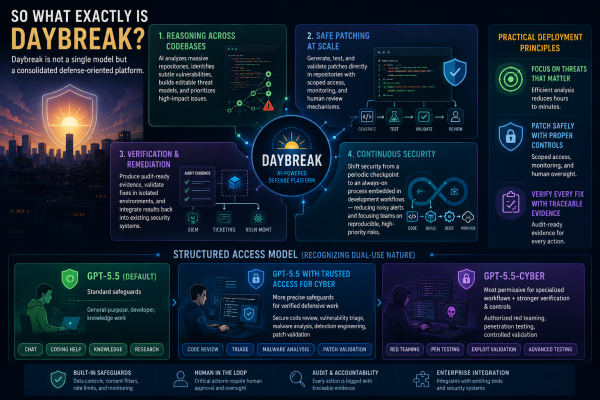
Daybreak is not a single model but a consolidated defense-oriented platform. Key elements include:
- Reasoning Across Codebases: AI can analyze massive repositories, identify subtle vulnerabilities, build editable threat models focused on realistic attack paths, and prioritize high-impact issues.
- Safe Patching at Scale: Generate, test, and validate patches directly in repositories with scoped access, monitoring, and human review mechanisms.
- Verification and Remediation: Produce audit-ready evidence, validate fixes in isolated environments, and integrate results back into existing security systems.
- Continuous Security: Shift security from a periodic checkpoint to an always-on process embedded in development workflows — reducing noisy alerts and focusing teams on reproducible, high-priority risks.
OpenAI outlines practical deployment principles:
- Focus on threats that matter (efficient analysis reducing hours to minutes).
- Patch safely with proper controls.
- Verify every fix with traceable evidence.
Recognizing the dual-use nature of these tools, OpenAI implements a structured access model:
GPT-5.5 (default) -Standard safeguards, General-purpose, developer, knowledge work
GPT-5.5 with Trusted Access for Cyber - More precise safeguards for verified defensive work, Secure code review, vulnerability triage, malware analysis, detection engineering, patch validation
GPT-5.5-Cyber - Most permissive for specialized workflows + stronger verification & controls, Authorized red teaming, penetration testing, controlled validation
This tiered system, building on earlier Trusted Access for Cyber expansions, aims to expand defensive capabilities responsibly while maintaining strict account-level controls for the most powerful configurations.
What This Means for Cybersecurity Companies
Over the last few months, we have seen stock prices of leading cybersecurity companies like Palo Alto Networks, CrowdStrike, Zscaler, and others take a beating. Some of that is market rotation, some of it is valuation pressure, and some of it is probably investors asking a very uncomfortable question:
If AI can both attack and defend software faster than humans, what happens to the traditional cybersecurity stack?
For decades, many cybersecurity companies built very strong businesses around defense systems designed for relatively predictable attack patterns. Yes, the threats evolved. Yes, the tools became more adaptive. But a lot of the operating model still depended on periodic scans, manual reviews, signatures, rules, alerts, dashboards, audits, and long reports that made everyone feel productive until the next breach happened. With frontier models, attackers may be able to discover vulnerabilities faster, test exploit paths faster, and automate reconnaissance at a scale that traditional human-led defenses were not designed to handle. That sounds scary, but from the enterprise buyer’s point of view, there is also good news.
Defenders now have a chance to operate at the same speed. Tools like Daybreak point to a future where security is not just bolted on at the end of the software development process. Instead, it becomes part of how software is built from the beginning. Code can be reviewed continuously. Attack paths can be modeled earlier. Patches can be suggested and tested faster. Developers can reason across entire codebases instead of chasing isolated tickets like digital squirrels.
🫤Dileep’s Skeptical Takeaway
We are moving into an era where cybersecurity becomes AI-vs-AI, with humans increasingly acting as supervisors to the AI Cyberdefense systems. Humans will not disappear from cybersecurity. But their role will shift. They will spend less time manually chasing every alert and more time deciding what these AI systems are allowed to do, when they are allowed to act, and how their actions are verified.
Enjoying What the AI?
Get a new edition every week, plus join the conversation on LinkedIn.
Subscribe on LinkedIn