Why is Gen Z booing AI?
What Happened
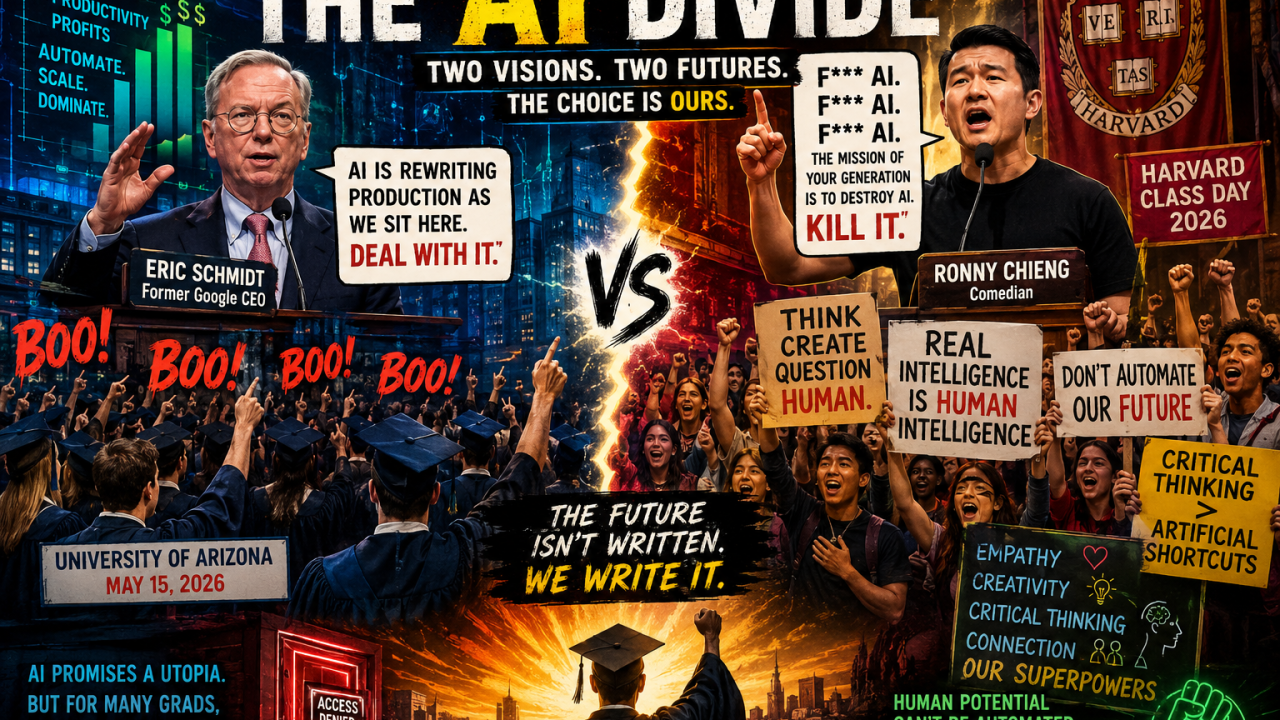
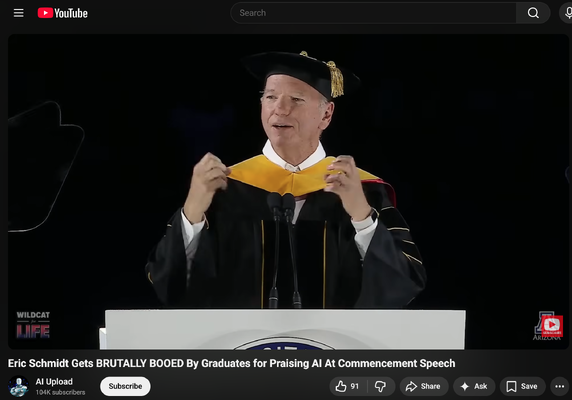
Do you have Teenage kids? Have you asked them what they think about using AI? I have two Teenagers - one in College, one in High school and they are mostly opposed to AI. Not only that, they are discouraged by their Teachers and Professors from using AI. So when I heard that the former CEO of Google Eric Schmidt was booed - yes, booed - when he brought up AI during a commencement speech, I wasn't exactly surprised. Turns out, at ceremonies across the United States, graduating classes have been openly revolting against the tech-optimism shoved down their throats by Silicon Valley elite. The Eric Schmidt episode was the most reported showdown on May 15, 2026, and it happened at the University of Arizona.
I do think this is the next industrial revolution...It will touch every profession, every classroom, every hospital, every laboratory, every person, and every relationship you have....I know what many of you are feeling about that. I can hear you. There is a fear in your generation that the future has already been written, that the machines are coming, that the jobs are evaporating... and that you are inheriting a mess that you did not create....AI is rewriting production as we sit here. Deal with it. - Eric Schmidt (Former Google CEO)
How the non-Elite talk about AI
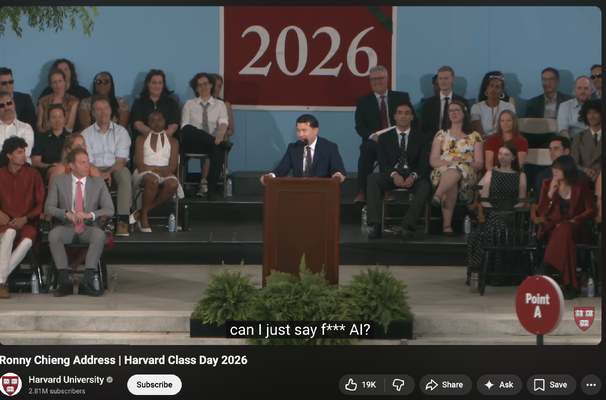
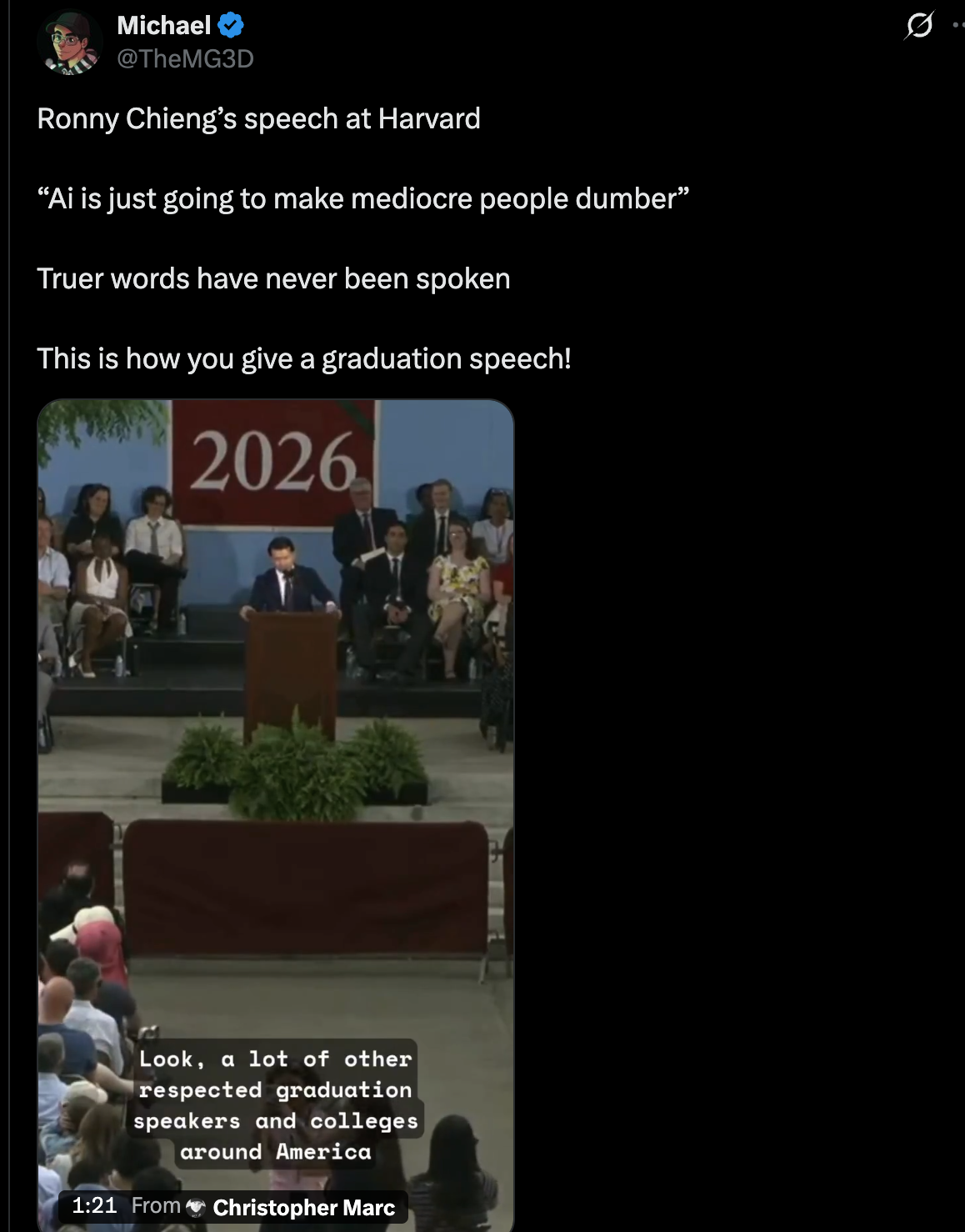
Meanwhile, across the country at Harvard University’s Class Day, comedian Ronny Chieng took the exact opposite approach, and walked away with a standing ovation. Chieng completely torched the pro-AI corporate narrative.
Can I just say f*** AI, f*** AI, f*** AI? Im glad you agree. Its so stupid. A lot of other respected graduation speakers at colleges around America are talking about you guys needing to master AI for the future. I’m here to tell you the mission of your generation is to destroy AI. Kill it. - Ronny Chieng (Comedian)
Chieng warned the crowd about the accumulation of cognitive debt driven by excessive reliance on large language models, explicitly citing an MIT study on how shortcuts rob us of the skills built during the struggle of creation.
Recommended by LinkedIn
 The U.S. and China are vying for AI dominance. Here’s…
Amy Webb
7 years ago
The U.S. and China are vying for AI dominance. Here’s…
Amy Webb
7 years ago
 What happens when AI cuts power to a hospital to keep…
philipp kobald
8 months ago
What happens when AI cuts power to a hospital to keep…
philipp kobald
8 months ago
 The Effort Paradox in the Age of AI
Ron Duren Jr
9 months ago
The Effort Paradox in the Age of AI
Ron Duren Jr
9 months ago
Why This Matters
For the past few years, the Tech oligarchs who make billions off our data have promised that AI will unlock a utopian paradise of 1000x productivity. But if you look at the ground reality through the eyes of the Class of 2026, that productivity looks a lot like a door slamming in their faces. I personally know at least a half-dozen recent College Grads (some with Computer Science degrees) who are struggling to find jobs. Entry-level tasks in coding, technical writing, basic analysis, and graphic design are being aggressively automated by tools like Cursor, Claude Code and Codex. Corporations are registering record revenues while keeping hiring freezes tightly locked on junior talent. Students have spent their formative academic years watching AI tools commoditize the very skills they went to college to learn.
A new class divide
The gulf I see between those who are Vibe coding using their $1000 API Tokens and those simply looking for an entry level coding job is hard to put in words. You have the Tech Bros on the All-in podcast calling Sam Altman, Elon Musk, and Dario Amodei every week - and they gloat about how mazing this new AI Revolution is, how it will cure Cancer, abolish Poverty and bring along a new Golden age of prosperity. These same folks are asking young grads to buy a $799 MacMini, and a $200/month Claude Code subscription to future-proof their careers. Meanwhile, these young adults are facing crushing student debt, skyrocketing housing costs, and an immediate threat to the white-collar career ladders that existed just 24 months ago. Ronny Chieng told those Harvard grads that the actual journey of doing the hard work, making the mistakes, and learning how to think critically is the only real differentiator left. The debate exploded on social media immediately following the ceremonies, exposing a massive rift between tech executives and everyday professionals. Many defended Eric Schmidt saying he is simply stating the economic reality. The historical data from the last 100 years proves that disruptive technologies always diminish legacy roles before creating entirely new industries. Grads booing a technology wont stop shareholders from demanding automated efficiency.
🫤 Dileep's Skeptical Takeaway:
Let's not tell 20-somethings to just deal with AI. Comedians have a way of connecting with and reading the room - especially a room full of young people - far better than a Tech Bro can ever dream of. And while it is absolutely true that the Graduating Class of 2026 has no choice but to accept the reality of AI eventually taking away majority of entry level Knowledge work, it is also true that they didn't ask for this. So while we Gen X-ers can't help but marvel at the beauty and speed of the AI Agent we asked Claude Code to write for us, let's not forget that there is a cost to this seemingly exponential boost to productivity - not just the cost of Energy and Cooling needed to run the massive Data Centers being built , but also the human cost of joblessness, frustration, and Student debt. The Pitchforks are coming.
Enjoying What the AI?
Get a new edition every week, plus join the conversation on LinkedIn.
Subscribe on LinkedIn